Nikon does fashion
Some random backstage and runway shots from Africa Fashion Week, taken last Thursday -
Shot with a Nikon D700 and a selection of fines Nikkors: 14-24/2.8, 24-70/2.8, 70-200/2.8 VR2, 105/2.8 VR. If I had to pick a favorite lens it would definitely be the 14-24/2.8, with the 105/2.8 VR Micro-Nikkor coming a close second. They are all, without exception, big and heavy lenses I wouldn't want to carry around all the time but they certainly produce the goods when needed!
Canon PowerShot S90
I've had a Canon S90 for a couple of months already and in that short time have already managed some really nice shots. It's barely larger than a candybar cellphone and the picture quality beats anything I've seen from a similar-sized cameras. I always felt the G10 is a touch too big to carry at all times, and the S90 fits this role perfectly. Lightroom 3 handles the noise really well if you shoot raw, though you will definitely need something like PTLens to straighten up the barrel distortion at the wider settings (if you shoot JPEG the camera corrects it internally but only partially; PTLens can fully correct the JPEGs too). As with other PowerShots, the IS is unbelievably good - here is a hand-held sample at half a second:

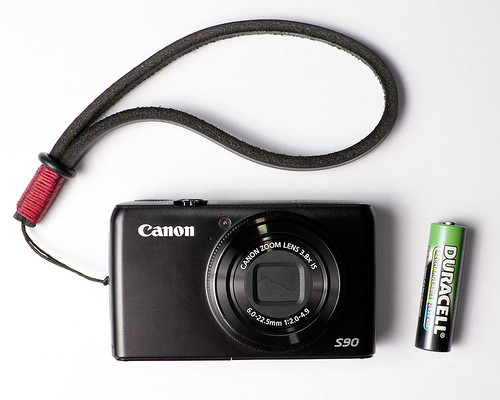
And to illustrate just how tiny it is - here's mine next to an AA battery (you might also recognize the Gordy's camera strap it's wearing):
Nikon expert Thom Hogan has posted his views on the S90 and sums it up much better than I could. I find the S90 a great camera for those times when I don't feel like lugging my SLR around. And since I've had a chance to handle the Olympus E-P1, I really don't lust after a m4/3 camera anymore even though I'm sure it's technically a better proposition.
Stop Buzzing me!
Google has rolled out Buzz to much discussion - reactions vary from "can't be bothered, turned it off" to "this is the new Twitbook killer". Here are some very unstructured thoughts on the subject.
Let me start with an observation on the two biggest players in this space. Twitter and Facebook are diametrically opposite in the way that their social links work - Twitter is asymmetrical where following someone has no implication for them. Befriending someone on Facebook on the other hand is a symmetrical relationship. (Facebook has tried to augment this, quite successfully, with the Pages feature.) These core properties also dictate the experience: Twitter serves up small slices of chatter and subscribers see updates fairly close in time to them being published. Facebook on the other hand personalizes your news feed and prioritizes items based on your past activity. (You can also choose to view the latest news from all your Facebook friends from a couple of iterations ago - see a pattern here?)
Buzz's major downside for me at the moment is that the popular posts tend to stay at the top, even if I'm not that interested in them. If you contrast to the above paragraph, you'll see how it fits right in the middle - you get a public conversation with the "buzzing" items floating up to the top. Google will probably tweak the post prioritization over time to get the signal-to-noise ratio lower (I would like a button to mute specific items for starters. Edit: ah, it's right there in the little triangle menu - silly me).
Jason Calacanis writes that "Facebook just lost half its value". I'm not convinced of that - for one, Facebook has iterated on their UI much more and is very good at catering to the use cases that people want from it, IMHO. Another is privacy concerns - for all the gaffes, Facebook does actually have working privacy controls. Google has a lot of catching up to do in pure features here. That is, if they even want to go there. My guess is that they'll stay out in the open like Twitter and sidestep the issue. Simple example: I would upload photos to Facebook that will never see Flickr or Google's Picasa data centres.
I also think that it's Twitter that may have lost half its value - in the 24h that I've had Buzz in my Gmail, I've seen much more potential to strike up a conversation in public on Buzz than I have on Twitter, which in turn tends to be quite impersonal until you have built something of a following. If Google provides an API with open access, Buzz could really become the centre of one's online universe. One potential killer feature (for technogeeks anyway) would be to aggregate ad-hoc social interactions such as comments on blog posts and forum posts from all over the internet. Blogger is already supported, all that's needed is push support in Disqus and vBulletin/phpBB . The challenge here will probably be minimizing noise - think Facebook app spam.
Related - Buzz from the corporate network. How many companies block access to the likes of Facebook? I'd guess quite a few, especially once you reach a certain size. Gmail on the other hand is often permanently open in a browser right next to the corporate Exchange mailbox. Short term advantage to Buzz here, but how long before the network policy declares it an enemy? Gmail is already on the borderline as it is with the embedded Google Talk feature.
I have turned Buzz off for the time being but I will keep revisiting it. I would have much preferred a standalone page which I can visit. As it stands, I find it very distracting in my Gmail. At the same time, I think that over time it will become a very useful tool. I suspect it will eat more into my Twitter usage than Facebook. And I should imagine that Buzz will really hit its stride once mobile support is rolled out.
Windows, NVIDIA, and oversaturated colours
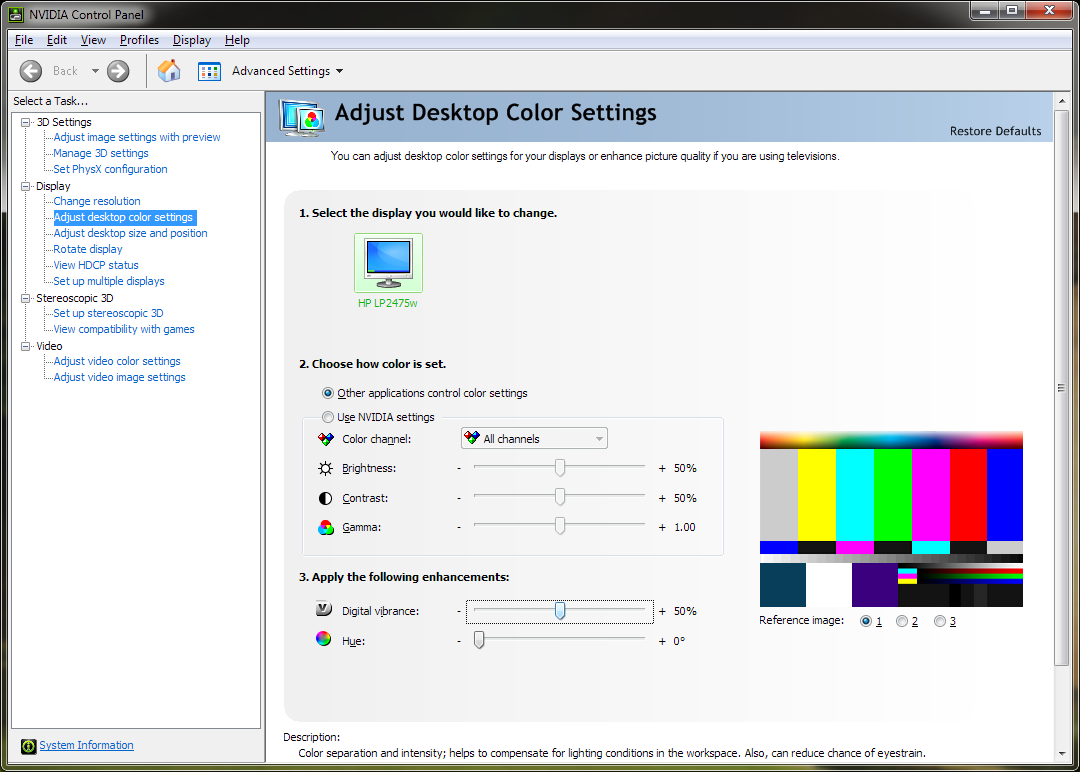 After a recent power dip, I had to reboot my machine and the colours went completely crazy. I have an HP 2475w wide-gamut monitor which can produce some seriously "dayglo" colours - e.g. the orange in the Firefox icon became an eye-searing hypersaturated red. Since my PC is on 24/7 for long intervals at a time, it was absolutely impossible to tell what had caused this. I had been evaluating some new raw converters recently so my initial guess was that some software I installed had made the change. After much frustration, uninstalling apps, and several reboots later, it turns out that the culprit is the latest NVIDIA drivers which default the "digital vibrance" setting to 90% (where it had previously been 50%).
WTF, NVIDIA? Please don't screw with my colours and focus on building better hardware instead. Secondly, how did this update get WHQL approval and made it into Microsoft's Windows Update? It's little things like this that have made all the pros move to Mac.
Lightroom 3 Beta begins with big improvements in image quality
I have been using Lightroom since one of the early pre-1.0 beta releases, and have enjoyed using it ever since. The release of the first public beta of Lightroom 3 last week was naturally an interesting event – what have they cooked up this time? According to the official release notes the major improvements are in the ACR rendering engine which processes raw sensor data into nice looking images. However I just wasn’t seeing any of the supposed improvements when looking at my files! Eventually I realized my mistake – because I imported some DNG files which had already been through Lightroom 2, the new beta was using the same old “process” in order to maintain the same appearance. As Larry Wall would say – “this is not a bug, it’s a feature!”
Lightroom was actually doing the right thing by preserving the original look of the images. All that was needed was to either reset the development settings (killing my adjustments in the process), or update to the latest process version (this is available from the Settings menu when in the Develop module). I have noticed that some of my images require a lot less sharpening under the new process and so would look rather over-sharpened when simply converted to the latest process. In other words there is a good reason why Lightroom does not automatically put your old images through the new process – it’s different enough that the results of your original adjustments may simply not look as good as they should. My advice would be not to do large-scale en masse conversion of entire folders or catalogs, rather convert individual images and reassess the adjustments made.
Now that I am seeing the output of the latest rendering engine, I can tell you that this alone will be worth the price of the upgrade for me. Colour noise handling is vastly improved, the luminance grain is tighter and there may even be a tad more detail visible in some borderline cases. Have a look at the following side by side crops and judge for yourself (click to see in full):
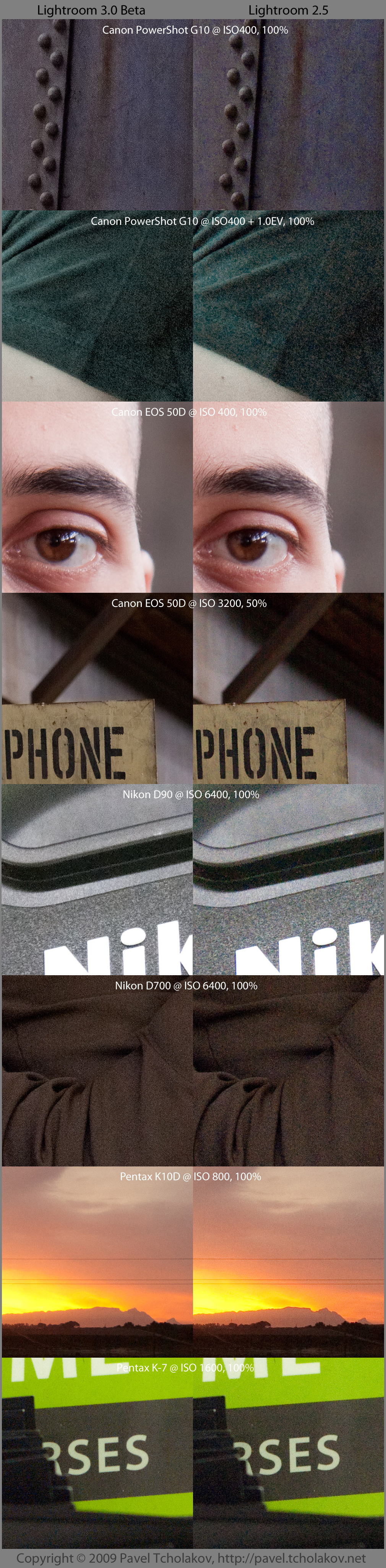
All files use the default Lightroom noise reduction settings – the colour noise reduction slider was set to 25, and luminance noise was set to 0.
The improvement in the G10 images is very impressive. Also note the much reduced vertical banding in the 50D ISO3200 sample #4 above (this is the only crop that is not 100% because the banding was not as obvious at the 1:1 magnification size). Overall, I am seeing ever so slightly more detail (e.g. the stitching in sample #2, eyebrow hairs in sample #3) and vastly reduced colour noise with a more pleasing grain pattern. The Nikon D700 does not show a huge improvement – I had to go through quite a number of ISO 6400 photos to find one that shows much of a difference, mostly because the files are so good to start with. The story is similar with the Pentax K10D in that it doesn’t show much improvement – the files are fairly noisy in the first place and stay that way even under the new process.
All the above files have easily discernable differences at full-screen view on my HP LP2475w (24” 1920x1200 LCD, or around 30% magnification depending on which camera the file comes from), except for the Canon 50D @ ISO 400 and the two Pentax shots. The differences between Lightroom 2.5 and 3.0 Beta rendering for these three images are basically invisible at smaller magnifications.
Another small but important improvement that I’ve noticed is the smoother movement of the adjustment sliders. Previously, some computationally-expensive adjustments would make the sliders very notchy as the image preview was being rendered every time you changed a value. Now the sliders can move freely all the time. This is a classic case of better use of multithreading leading to more responsive software. I haven’t done any actual testing but it seems as though the new beta is also utilizing my dual core CPU better during import/export. It only makes sense as CPUs with four or eight threads of execution are becoming increasingly popular, and Lightroom 2 has some known deficiencies in such configurations.
The Lightroom 3 beta is available to all at Adobe Labs (free registration required).
Orlando Power Station
The abandoned power station building, next to the Orlando Towers in Soweto. Some people like urban decay, I just love the industrial variety 

Canon G10 Gallery
While we wait for the G11 and S90 to show up, I uploaded some favorites that I've shot over the last couple of months with the G10.

Zune 4.0 Software
Hell has frozen over: Microsoft has built a piece of software that is more elegant, functional, and easier to use than Apple's new iTunes 9.
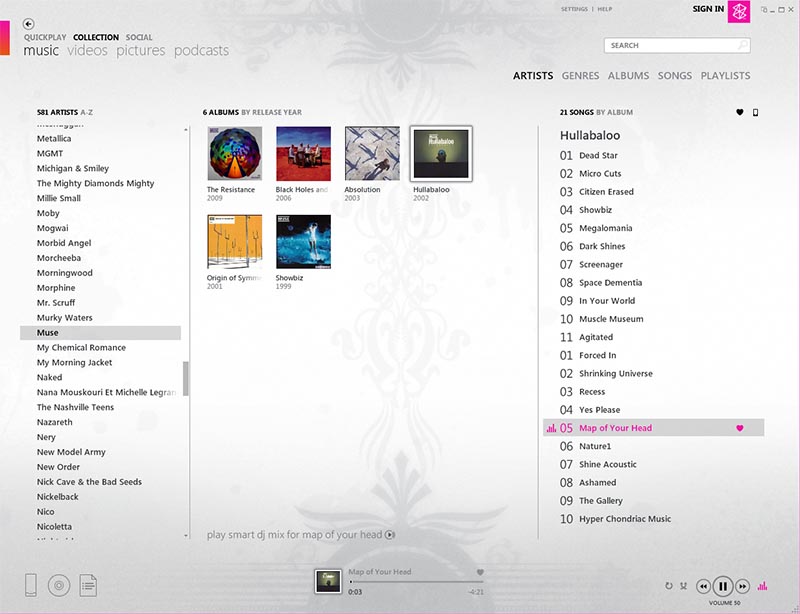
Zune 4.0 Software showing collection view of artist albums by release year
Grab Zune 4.0 Software or have a look at some screenshots first.
Now if anyone out there is listening, please can you make WMP 12 go the way of Outlook Express and make the Zune desktop software the new default? KTHXBYE!
Gordy’s Camera Straps
I never use the bundled neck straps for their intented purpose - usually I end up wrapping them a couple of times around my wrist so they don't get in the way too much. On occasion I might carry a camera over my shoulder on its strap but if it's out it's usually in my hand. Gordy's Camera Straps is a purveyor of finely crafted leather straps of all shapes and sizes. My black leather wrist strap arrived a couple of weeks back and I've been very happy with it. It's primarily intended to work with a compact camera but I discovered that it works just great with a much bigger DSLR too. The quality is outstanding and, depending on your style of shooting, this could be the perfect accessory to add a little retro flair to your camera of choice.
Here are a few shots of what it looks like on my G10 and K10D:
Also check out the customer gallery on Gordon's website which showcases many the different styles and colours available.
Verdict: highly recommended! (It should match my future S90 quite nicely, methinks.)
Developers, developers, developers
Yes, what else, I'm referring to the infamous Steve Ballmer going crazy on stage scene. Bruce Eckel recently wrote in a blog post:
He's right, developers are important. And if you only go to Microsoft conferences, it looks like all developers are using Windows. But if you go to any other developer conference, everyone is using Macs.
Which got me thinking, WTF is up with the Windows command prompt? If there's one thing developers need, it's a solid command line interface which lets them manipulate OS primitives with the minimum of fuss. So why do I find myself installing Cygwin and puttycyg on every Windows machine that I need to get some work done with? Maybe I'm just a *nix die-hard who's too stubborn to learn something new but it works great, for the most part (what's wrong is the subject of another rant altogether).
Some will probably say that PowerShell is meant to be the answer but I disagree. It may be nice for scripted rolling out of patches and performing other sysadmin-type tasks en masse but c'mon, who wants to use that as their shell? Even if you were willing to dig deeper and learn the arcane syntax, you're still stuck in the same old DOS box "terminal" that the regular cmd.exe runs in. Even trivial operations like resizing the window or copy & paste are a misson. A Google search for "Those who don't understand UNIX are condemned to reinvent it, poorly" returns a similar rant about PowerShell as one of the top results so clearly I'm not the only one frustrated by it. It all sounds very good on paper what with the pipes on steroids and .NET integration but it somehow fails to provide a shell replacement.
Are all Windows developers hopelessly stuck somewhere deep inside the Visual Studio GUI? (The ones that haven't migrated to the Mac yet, anyway?)